
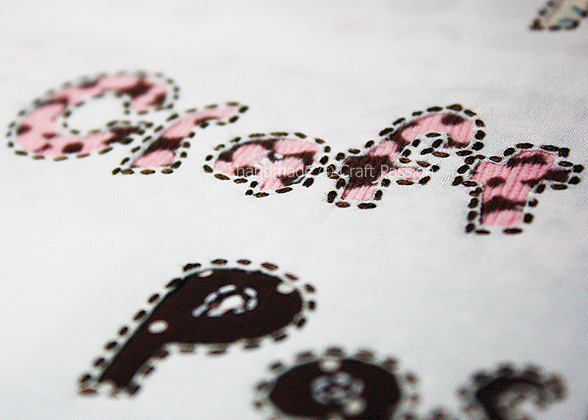
I am into serious thinking about redesigning my header recently. Though the existing header which was done by my friend’s niece looks good but I want something really represent my handmade skill. What about I sew my own header instead of using computer graphic for it. That’s how I came out with the idea of reverse applique of “Craft Passion”. While making it, I think of you! May be you want to try it out and make your favorite design into a reverse applique embellishment 😉 Here is the sewing tutorial!
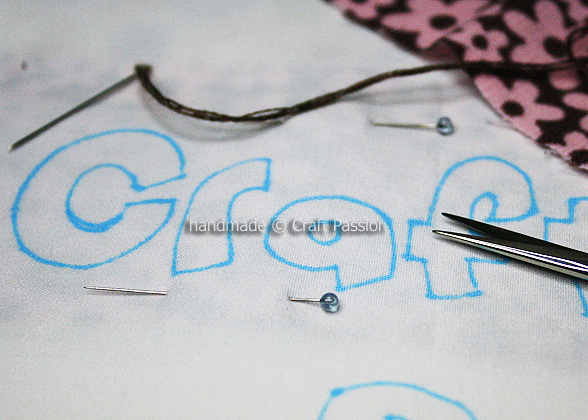
1. Use an erasable fabric marker to draw the design on the fabric surface you want to place a reverse applique motif. Place a contrasting fabric at the bottom of your design, secure both layers with pins. The bottom fabric should have at least 1/2″ allowance from the outline of the drawn design.
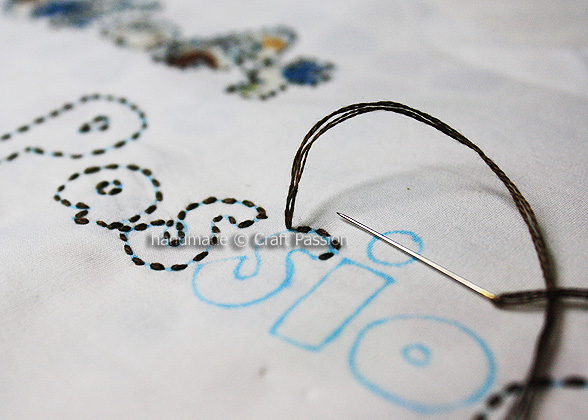
2. With thread/embroidery floss and needle, sew both layers with the type of stitches you want, I sewed with running stitch for this instance. If your design is big with less curvy outlines, you might want to consider using sewing machine to do the job since it helps you to accomplish the project faster. Either straight line or zigzag stitch will be a good idea for reverse applique by sewing machine.
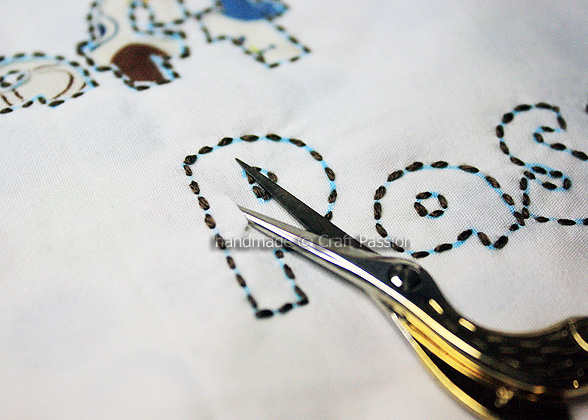
3. After you have finished with the sewing, use a sharp point scissor to cut out ONLY the top fabric. You have to do this carefully and precisely, about 1mm-2mm from the edge of the stitching line. I used my favorite DMC scissor for this job as I don’t want to risk my work by accidentally cut the stitches or the bottom fabric by mistake. As always, in order to have a nice piece of handmade, I emphasized on using the right tool for the right job.
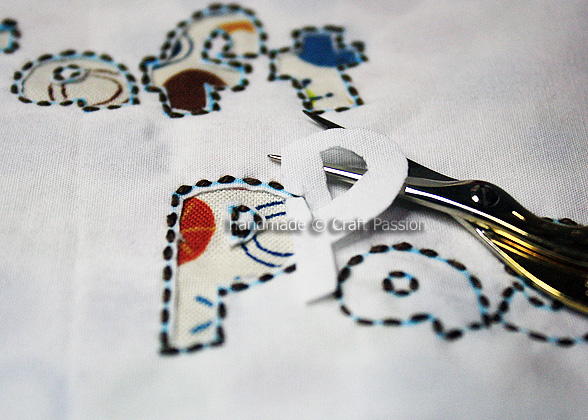
4. This is how a reverse applique looks after removing the top fabric. You are not confined to only 2 layers of fabric in reverse applique, you can add as many layers as you want depending on your design, but be sensible otherwise your project will be too thick. Notice the different between the top and bottom pictures of both “P” I have made? Look carefully at the center cavity of the alphabet!!!
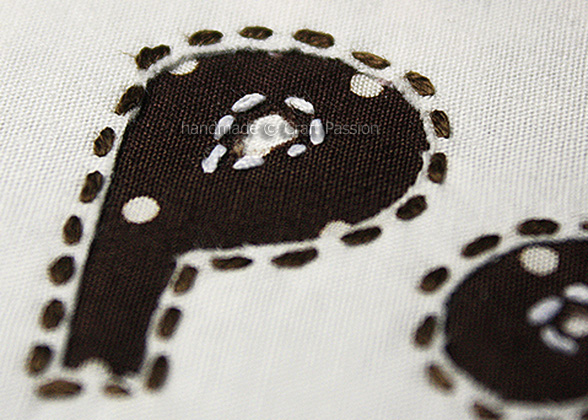
5. This is the example 3-layer reverse applique where the cavity is another layer of white fabric at the bottom of the brown fabric.
As you know, woven fabric will fray a bit at the edge. If you are making it for everyday-use project, like garment and bag where washing is needed for example, I would suggest that you use back-stitch (hand sewn) or zig-zag (machine sewn) as this will let your work last longer.
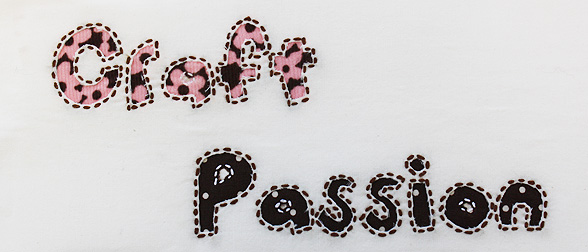
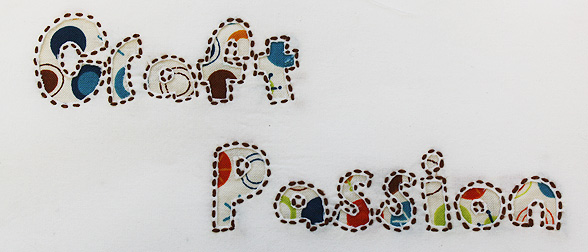
I did 2 and I don’t know which to choose for my header as I like both of them. Will you help me to choose?
Angela Maria Agostinho Pereira
Thursday 16th of May 2013
Olá !! Quero lhe agradecer muito por compartilhar... Fiquei super feliz em aprender essa técnica nem imaginava como era feita!!! Voce é muito especial...grande abraço Saudações de Curitiba ,Paraná - Brasil
Translation (by Google): Hello! I want to thank you very much for sharing ... I was super happy to learn this technique no idea how it was made!! You are very special big hug ... Greetings from Curitiba, Paraná - Brazil
Ellie
Sunday 2nd of December 2012
Thank you for tutorial. I like the first one, it is easy to read.
Shannon Margaret Brott
Wednesday 15th of December 2010
I prefer the first one but would love to have seen them close together or next to each other for a cute header.....Greatjob! :)
Tiryaki
Tuesday 10th of August 2010
the first one :) the second one is hard to read. but they are so cute..
loves from Türkiye...
Monika Schappert
Sunday 20th of September 2009
Wow, nice effect. I'm going to use it for the kid's t-shirts. Too bad they are still too young to read it. I'd take the first because of the contrast.